Trey continued to run the smaller RST BASE model combined with two RST 4-channel Expanders as the core switching function at the heart of his guitar rig for Summer 2023. The number of effects units in the rig was relatively small compared to recent years, but Trey squeezed enormous amounts of effects power out each of them, none more so than the Line 6 M5 Stompbox Modeler, which got additional preset banks in the RST system to broaden its capabilities.
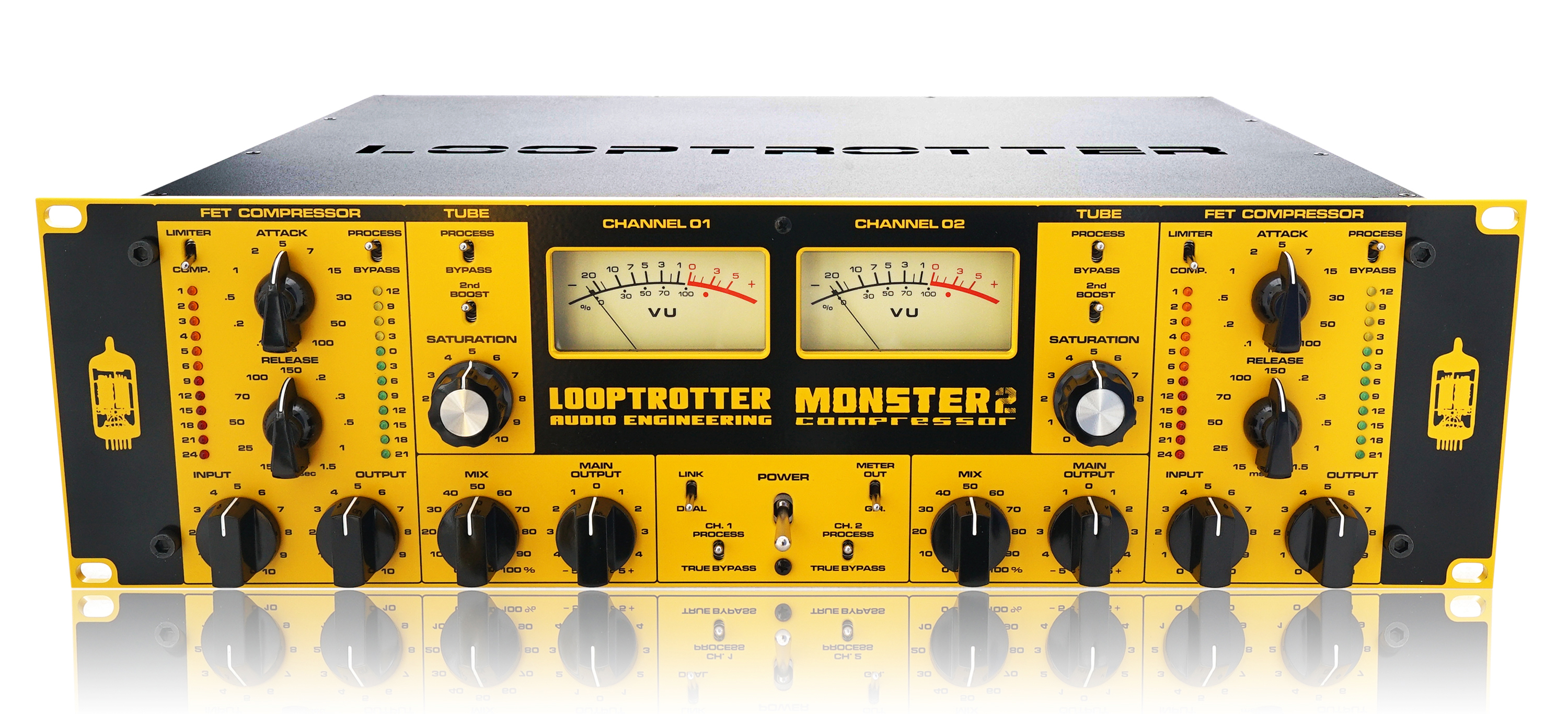
The Looptrotter Monster Compressor that was prominent at Trey Trio and some TAB shows was on stage for Summer Tour and mostly behind Trey’s rig facing back. The Ross Compressor was also in use at least intermittently throughout. We talk more about the Monster below.
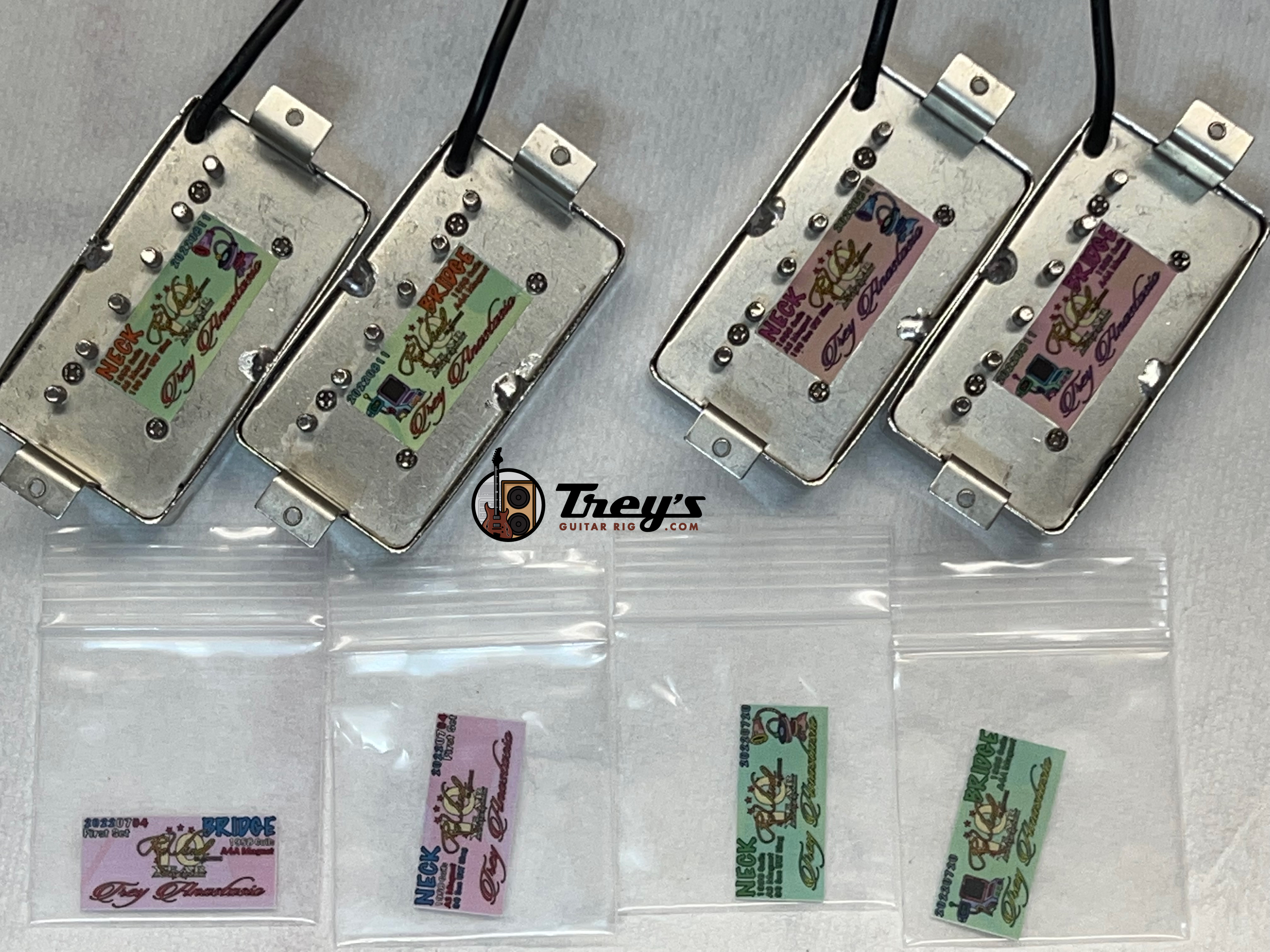
We’re excited to share that Trey is using a new humbucker set designed by James Finnerty at Rewind Electric. These pickups were designed in Summer 2021 and installed in the guitars shortly thereafter. More recently, the wiring harness in Trey’s Koa 1 guitar was replaced with a 50s-style wiring harness, which eliminates the coil drop and series/parallel functionality. James is calling this PAF-style humbucker the “TAF” for obvious reasons. More on these and the rest of the rig below.
Electric Guitar Amplification:
• 1 x Trainwreck Express
Electric Guitar Cabinets:
• Bruno 1 x 12. This cabinet is mic’d with a Royer R-122V vacuum tube ribbon mic and a Shure Beta 57a. There’s a second Bruno 1×12 as backup, but it was occasionally used as a second primary, creating a 2×12 array. • Leslie G-37 guitar rotating speaker (triggered by a Boss FS-5U at Trey’s left foot)
ElectricGuitars:
• Koa 1. Single output, no push-pull, no coil drop switches, no series/parallel. This guitar uses 50’s wiring for a super simple and very toneful setup.
Voicing • Digitech Whammy II. • CAE Wah. • Line 6 M5 Stompbox modeler PRE. The PRE unit is at the beginning of the effects chain and has multiple presets, including: “Growl”, “Synth”, and “Octave”.
Time-Based (reverb and delay) • 1 x Way Huge Supa Puss • Line 6 M5 Stompbox modeler POST. The POST unit is at the end of the effects chain and has multiple presets, including: “1024” (designed to emulate the Ibanez DM2000), “Sweep Echo”, and “Reverse”. • Boomerang Phrase Sampler (ONCE effect is triggered by an FS-5U above the Whammy)
Modulation • Nux Monterey • Victoria Reverberato (triggered by a Boss FS-5U at Trey’s left foot)
Wet Rack • Bricasti Design Model 7 Stereo Reverb Processor. The Bricasti is a studio reverb that takes a split from the Bruno cabinet mic, adds reverb, and then sends it directly to Trey’s in-ear monitors and the front-of-house mix for the audience to hear. Previously, they had sent the reverb signal into stereo 1×12 “wet” speakers that sat on either side of the Bruno 1×12. Because the signal is going straight to the mains and monitors, those additional speakers have been removed.
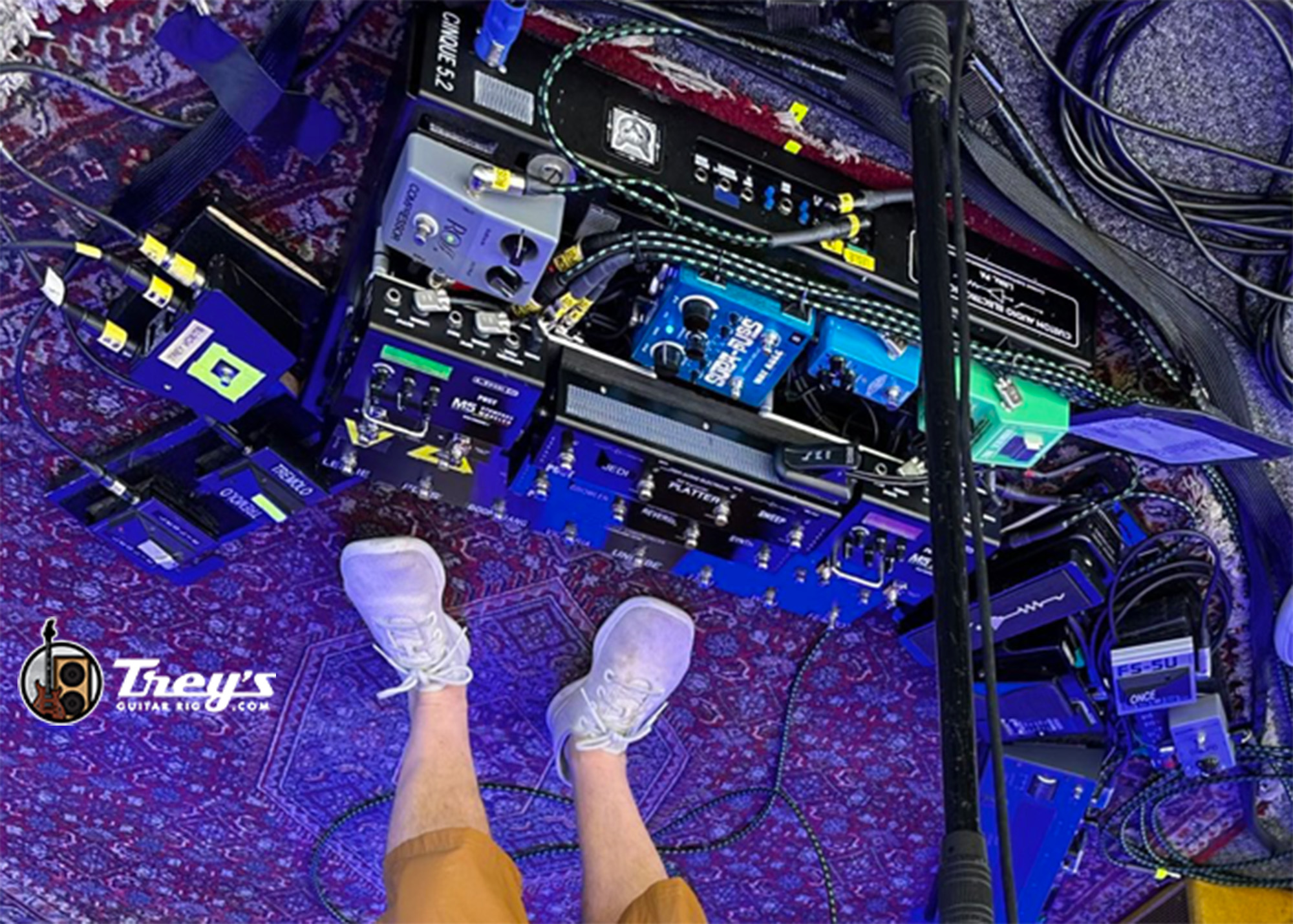
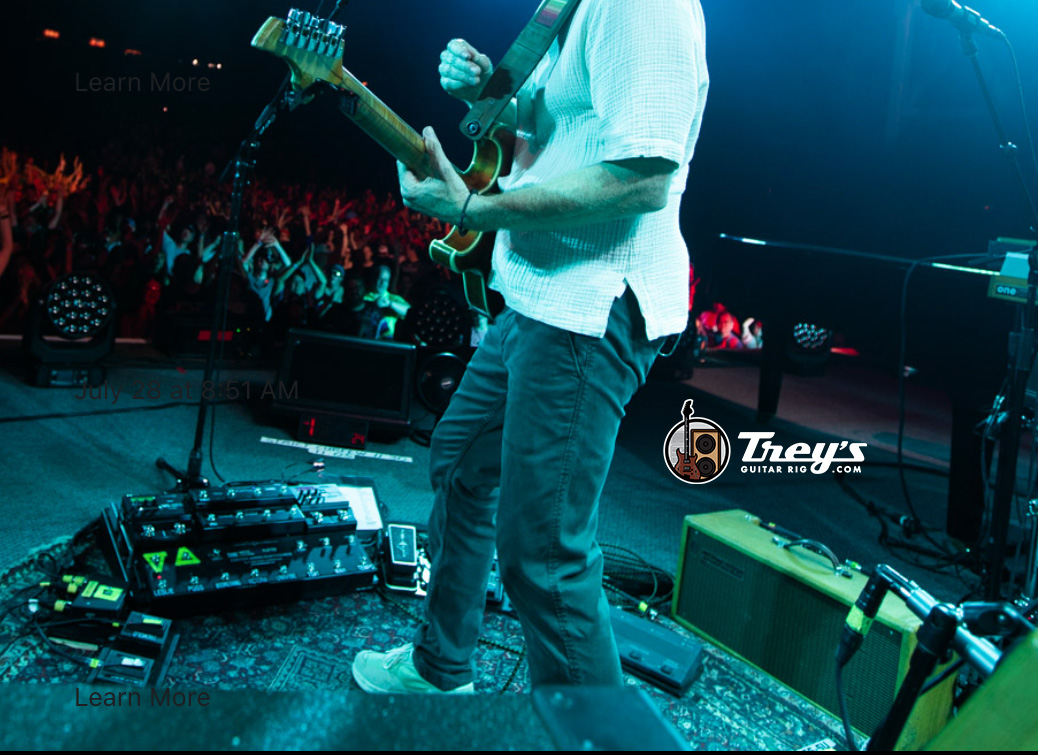
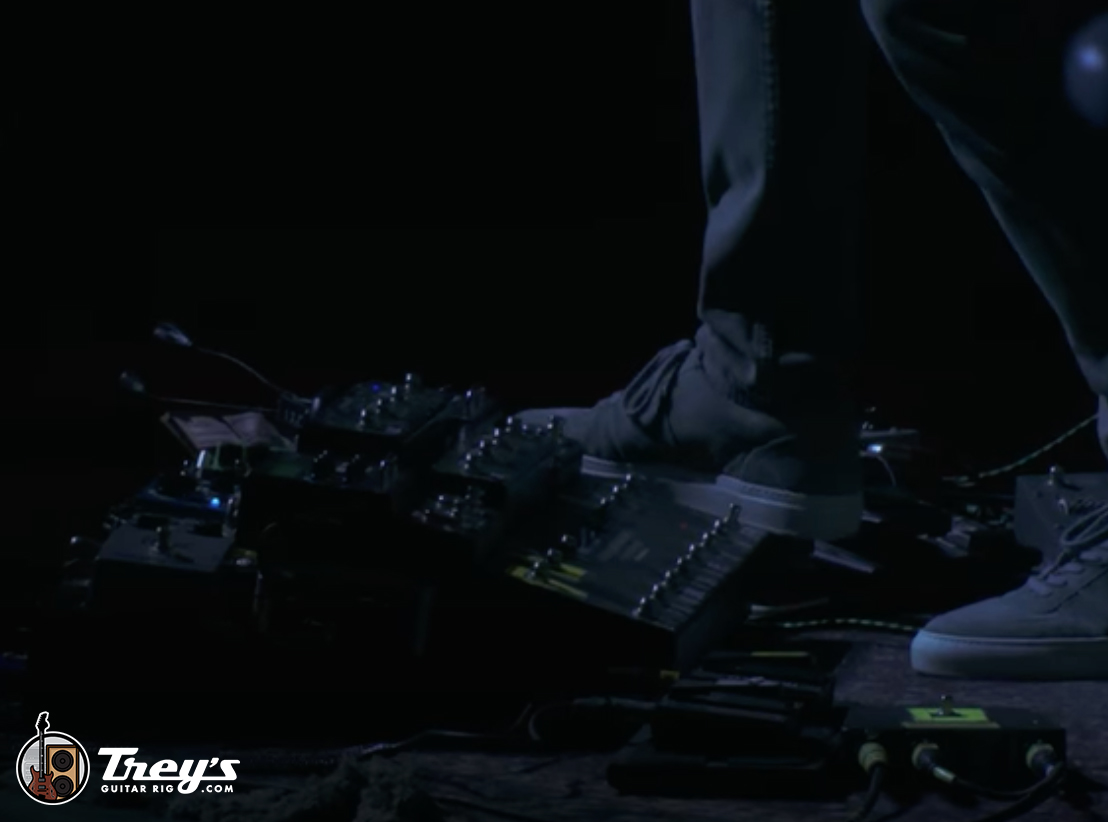
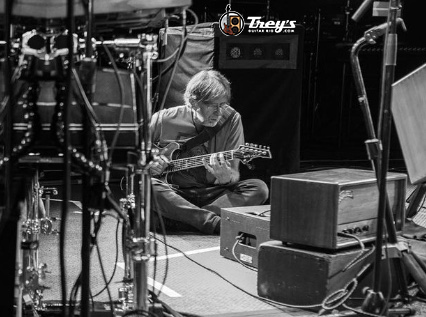
This photo (via Mike’s instagram) from Alpharetta gives us a good idea of the full rig. The Boss FS-5U pedals at Trey’s left foot (Fishman’s feet in this pic) are Leslie on/off and Reverberato Tremolo on/off. The switch above them is Trey’s talkback mic. On the bottom right, you can see the MXR Noise Suppressor that quiets the Boomerang and the FS-5U that triggers the ONCE function on the Boomerang, used in Heavy Things. The Expander at the top has three settings – JEDI (the classic tremolo stutter that sounds like a light saber), Platter, and Sweep. At bottom I can read REVERSE in the center button. There appears to be only a single Tube Screamer at this point in the tour.Here’s a look at most of the floor array from Alpharetta on July 15. At Trey’s left are the two Leslie G-37 controls. The large board in the middle has the RST BASE plus two expanders. And the M5’s are on either side of the expanders. You can see the wah above Trey’s foot. His leg is obscuring the Whammy. The Boomerang and Victoria Reverberato are to his right.For some shows, including this July 28 show at MSG, Trey used both his main and backup speakers to create a 2×12 array. You can see the gray Ross compressor at the corner of his board.In this close-up of the floor array from July 12, you can see the Ross compressor again. The switch in the bottom right of this photo is Trey’s talkback mic, which he can use to communicate with the band. On the RST BASE, you can see the yellow tape around the top left switches. Those allow him to scroll through the various preset banks that control the M5. Each RST expander has four switches and controls an M5. One is for PRE and the other for POST. One of the four switches is dedicated to bringing the unit in or out of the chain. So that leaves only three presets for each unit. But with these “BANK” controls, Trey can add three new presets for each bank, making the number of presets available effectively limitless.These are the Rewind pickups that went into Treys guitars in 2021. On his website, Finnerty says: “In the summer of 2021, James Finnerty worked with Trey Anastasio and his tech Justin Stabler to custom design some PAF-style pickups and electronics for voicing Trey’s amazingly unique style and equally unique Languedoc guitars. These ReWind Electric pickups that James designed have remained in the guitars ever since, with almost no variation among the several different Languadocs in rotation. These pickups are not replicas of any one set of P A Fs, like many models on this page. Rather, they are an amalgamation of design features and materials taken from several different P A Fs, with some particular embellishment in coils, based on applied knowledge from study and repair of vintage P A Fs, specifically crafted to compliment the unique voice of the Languedoc guitars. Now, the sound of those custom design pickups are available to everyone. Of course, the pickups are only a small slice of Mr. Anastasio’s wonderful guitar tones so you’ll need the right instrument, rig, technique, and a lifetime of practice if you want to get close. Having a great tech like Justin and a touring support crew of 19 semi trucks wouldn’t hurt, either!”This is the version of the TAFs that are currently in Koa 1. These pickups were installed with the 50s wiring schematic in July 2022. Note the braided shield hookup leads on these, as opposed to the plastic insulated wiring on the 2021 set. Photo courtesy of Rewind Electric.In this photo from backstage at MSG on August 4, you can see Trey’s simple backstage practice rig. A Fender Princeton Reissue, a CAE Wah, and two TS-9 Tube Screamers powered by a Voodoo Labs Pedal Power.This photo from August 25 at SPAC gives us a good view of the whole rig. Under Trey’s right knee, you can see the Trainwreck head. At bottom right, you can see the G-37 and the custom Bruno 1×12. At bottom left, you can see the pedals that are brought in and out of the chain by the RST system. From left they are: 2xTS-808 Tubescreamers, 1 Way Huge Supa Puss, 1 Nux Monterey, and 1 Ross Compressor. Just above the Ross is one of the two Line 6 M5 pedals (POST). The PRE M5 pedal is at Trey’s right foot side.In this beautiful capture by Rene Huemer, Trey is working on tweaking the settings of the Looptrotter Monster 2 Compressor after soundcheck. His Trainwreck is in the foreground. July 25, 2023.This is the Looptrotter Monster 2 Compressor (source: Looptrotter.com). As the picture suggests, it’s a very powerful and sophisticated studio tool. Vance Powell, who has done engineering and production work with Trey, used these in studio. Looptrotter says: “Monster Compressor 2 is a device with a „right in your face character”. It was redesigned to complement the „soulless”, „super clean” digital technology and by adding color and life. The compression module evens the signal in a very pleasant and musical way, before the tube saturation. The unique combination of compression and tube saturation makes the sound seem distinctly closer, every detail stands out and gives the energy to the processed sound. It makes the sound more tactile and ear friendly.”
I am flabbergasted that there are two compressors in this chain. What are they doing?! His upper registers are so brittle, shrill, and shrieky, it causes physical pain in my ears even with earplugs in. Just awful and heartbreaking.
Definitely. I was asking, what are they (the compressors) actually doing because anything he plays past the 9th fret is very painful due to the out of control highs. And any chords being strummed are mostly errant harmonics and pick noise rather than actual chord tones. Any insight as to what’s going on here?
The 50’s wiring has more to do with the interaction of the volume and tone control rather than the series/parallel aspect. That has more to do with 2 conductor vs 4 conductor wiring. 50’s wiring makes the volume and tone controls interactive rather than separate from each other as with ‘modern’ wiring. It also results in a brighter tone when the volume is rolled down which is helpful for clean up with touch sensitive inputs like the Trainwreck.
If his pick ups have 4 conductor wire (which according to ReWind Pickups they are not) then, yes you can keep the series/parallel switches. 2 conductor and 4 conductor pertains to the wire that comes out of the pickups themselves. Hope this helps.
I love this work you do, Ryan! Thank you!
For anyone who wants to really nerd out about this pickup stuff…
A humbucker is two single coils together with opposite magnetic polarity.
This is why it ‘bucks the hum’. Check your 2 and 4 position on a strat – no 60hz hum.
4 -conductor has the start and end of each coil available to configure the way you like.
This allows for one coil going into the other (series) – fatter, more compression, more mids.
Or… parallel (both at the same time – think speaker cabs) – thinner, clearer, less compression.
Additionally, 4-con can have a single coil (coil cut) setting – one coil by itself.
2-conductor forces the end user to use the pickup in the way it was made – (usually series.)
~~
50’s vs 60’s wiring…
This all has to do with where the TONE pot takes a feed off of the volume pot.
A tone circuit is bleeding high end to ground.
50’s – Takes a feed off of the OUTPUT of the volume pot – brighter and less high end loss w volume pot rolled down, but the tone knob has a larger effect on the total tone and output.
Modern/60’s – Takes a feed off the INPUT of the volume pot – less effect on total tone and output, but more high end loss when volume pot rolled down.
~~~
Some players prefer one over the other. There’s no “better” setup.
I myself grew up on a Telecaster. Simple. After owning many guitars and experimenting with way too many different pickup configurations, I’ve figured out (for me) simpler is better. This is also coming from a luthier that has worked on and modified many instruments and listened carefully to the player/owner.
Pickup choice and setup is most important.
The less you have to think about small settings and details, the more you can let go and be free while playing.
If it sounds good, it is good!
Thank you, Ryan! Great as always…especially curious about the “1024” (DM2000 style) delay on the Line 6 M5. I have an M5, but that effect name does not ring a bell. Is it another delay that Trey renamed as such? Did they download it from somewhere? Not seeing anything online so figured I’d ask…thanks!
Awesome write up! That visible 800 in the first pic is definitely an Analogman Silver mod. You can see the text sticker on the knob facing angled panel and the RE-J sticker just above the switch. Sorry I’m an Analogman nerd. 🙃
Pretty surprised about the Nux pedal making it into the rig. There’s lots of other Univibe style pedals out there, wonder why the change? (My favs are Lovepedal Pickle Vibe and JHS Unicorn)
Great work as always, Ryan! My thinking is that it’s time to drop the Trainwreck. It just doesn’t have the SOUND that Phish requires (just one man’s opinion). To my ears, even when Trey perfectly nails the composed sections of the old tunes, it doesn’t sound “right”. The cleans are shrill, causing Trey to compensate and alter his playing to accommodate the amp. While I understand that these original Trainwrecks are a treasure, they just don’t play nicely with Phish’s tunes. My personal favorite tones from Trey (and in general) are the Bill Carruth modified Deluxe Reverbs (amazing tones) and his CAE 3-Channel Preamp/Groove Tubes Power Amp combo. Those rigs gave Trey the freedom to play how he wanted to without having to account for unwanted distortion.
The M5 doesn’t come close to emulating the DM2000. It’s unfortunate. I especially miss the hold and slow mod functions. The DM2000 was a staple of his sound for 30 years and I can’t believe he ditched it. Oh well!
I’ve heard what sounds like unsync’d loops in 97-00 shows but most recently it sounds like they’re sync’d with the music.
I’ve been using a Chase Bliss Mood mk1 and a Mk2 on my board for similar ambient loop stuff in jams but have started to get curious about using midi to sync. Pros and cons of both set ups.
Has anyone noticed the new effects going on the last few runs? It looks like hes also got a deluxe reverb head now. Its really inspiring to keep watching him change and grow!






 Trey's Guitar Rig
Great work, as usual!
LikeLike
In the July 28 pic you can see the Ross has no cable attached. Seems like he’s only using the big yellow comp now?
LikeLike
Seems like he was alternating. I know at SPAC it was the Ross.
LikeLike
I am flabbergasted that there are two compressors in this chain. What are they doing?! His upper registers are so brittle, shrill, and shrieky, it causes physical pain in my ears even with earplugs in. Just awful and heartbreaking.
LikeLike
As I understand it he has not used both compressors at the same time. He’s using one or the other at any given moment or on any given night.
LikeLike
Definitely. I was asking, what are they (the compressors) actually doing because anything he plays past the 9th fret is very painful due to the out of control highs. And any chords being strummed are mostly errant harmonics and pick noise rather than actual chord tones. Any insight as to what’s going on here?
LikeLike
The 50’s wiring has more to do with the interaction of the volume and tone control rather than the series/parallel aspect. That has more to do with 2 conductor vs 4 conductor wiring. 50’s wiring makes the volume and tone controls interactive rather than separate from each other as with ‘modern’ wiring. It also results in a brighter tone when the volume is rolled down which is helpful for clean up with touch sensitive inputs like the Trainwreck.
LikeLike
Fantastic work and info! Meant to include this with my other comment and ADHD won.
LikeLike
Thanks – and thanks for the 50s note. So as you understand it, he could run 50s wiring and also keep the extra switches in?
LikeLiked by 1 person
If his pick ups have 4 conductor wire (which according to ReWind Pickups they are not) then, yes you can keep the series/parallel switches. 2 conductor and 4 conductor pertains to the wire that comes out of the pickups themselves. Hope this helps.
LikeLike
I love this work you do, Ryan! Thank you!
For anyone who wants to really nerd out about this pickup stuff…
A humbucker is two single coils together with opposite magnetic polarity.
This is why it ‘bucks the hum’. Check your 2 and 4 position on a strat – no 60hz hum.
4 -conductor has the start and end of each coil available to configure the way you like.
This allows for one coil going into the other (series) – fatter, more compression, more mids.
Or… parallel (both at the same time – think speaker cabs) – thinner, clearer, less compression.
Additionally, 4-con can have a single coil (coil cut) setting – one coil by itself.
2-conductor forces the end user to use the pickup in the way it was made – (usually series.)
~~
50’s vs 60’s wiring…
This all has to do with where the TONE pot takes a feed off of the volume pot.
A tone circuit is bleeding high end to ground.
50’s – Takes a feed off of the OUTPUT of the volume pot – brighter and less high end loss w volume pot rolled down, but the tone knob has a larger effect on the total tone and output.
Modern/60’s – Takes a feed off the INPUT of the volume pot – less effect on total tone and output, but more high end loss when volume pot rolled down.
~~~
Some players prefer one over the other. There’s no “better” setup.
I myself grew up on a Telecaster. Simple. After owning many guitars and experimenting with way too many different pickup configurations, I’ve figured out (for me) simpler is better. This is also coming from a luthier that has worked on and modified many instruments and listened carefully to the player/owner.
Pickup choice and setup is most important.
The less you have to think about small settings and details, the more you can let go and be free while playing.
If it sounds good, it is good!
LikeLike
Thank you, Ryan! Great as always…especially curious about the “1024” (DM2000 style) delay on the Line 6 M5. I have an M5, but that effect name does not ring a bell. Is it another delay that Trey renamed as such? Did they download it from somewhere? Not seeing anything online so figured I’d ask…thanks!
LikeLike
It’s just the digital delay set to 1024 ms and renamed.
LikeLike
Dynamic Delay is what you’re after.
Click to access M5%20Model%20Gallery%20-%20English%20(%20Rev%20D%20).pdf
LikeLike
Thanks guys this is fun! Nice work. Great resource.
LikeLike
Awesome write up! That visible 800 in the first pic is definitely an Analogman Silver mod. You can see the text sticker on the knob facing angled panel and the RE-J sticker just above the switch. Sorry I’m an Analogman nerd. 🙃
LikeLike
Pretty surprised about the Nux pedal making it into the rig. There’s lots of other Univibe style pedals out there, wonder why the change? (My favs are Lovepedal Pickle Vibe and JHS Unicorn)
LikeLike
First time here – love the level of detail and photos!
LikeLike
Great work as always, Ryan! My thinking is that it’s time to drop the Trainwreck. It just doesn’t have the SOUND that Phish requires (just one man’s opinion). To my ears, even when Trey perfectly nails the composed sections of the old tunes, it doesn’t sound “right”. The cleans are shrill, causing Trey to compensate and alter his playing to accommodate the amp. While I understand that these original Trainwrecks are a treasure, they just don’t play nicely with Phish’s tunes. My personal favorite tones from Trey (and in general) are the Bill Carruth modified Deluxe Reverbs (amazing tones) and his CAE 3-Channel Preamp/Groove Tubes Power Amp combo. Those rigs gave Trey the freedom to play how he wanted to without having to account for unwanted distortion.
LikeLike
The M5 doesn’t come close to emulating the DM2000. It’s unfortunate. I especially miss the hold and slow mod functions. The DM2000 was a staple of his sound for 30 years and I can’t believe he ditched it. Oh well!
LikeLike
Do you know if the Boomerang is midi sync’d?
I’ve heard what sounds like unsync’d loops in 97-00 shows but most recently it sounds like they’re sync’d with the music.
I’ve been using a Chase Bliss Mood mk1 and a Mk2 on my board for similar ambient loop stuff in jams but have started to get curious about using midi to sync. Pros and cons of both set ups.
LikeLike
Has anyone noticed the new effects going on the last few runs? It looks like hes also got a deluxe reverb head now. Its really inspiring to keep watching him change and grow!
LikeLike
Does anyone know if the M5 “pre” sits before or after the drive section?
LikeLike
Now that I just ordered an Ambikab, why did Trey quit using it? lololol
LikeLike